TL;DR
Commercial office greywater recycling converts lightly used sink and appliance water into a valuable resource for flushing fixtures and cooling systems. Commercial facility operators can drastically lower municipal utility bills while protecting property asset value against rising water costs. Implementing automated recycling systems gives commercial real estate properties a competitive edge in green building certifications.
Understanding On-site Commercial Water Reuse Systems
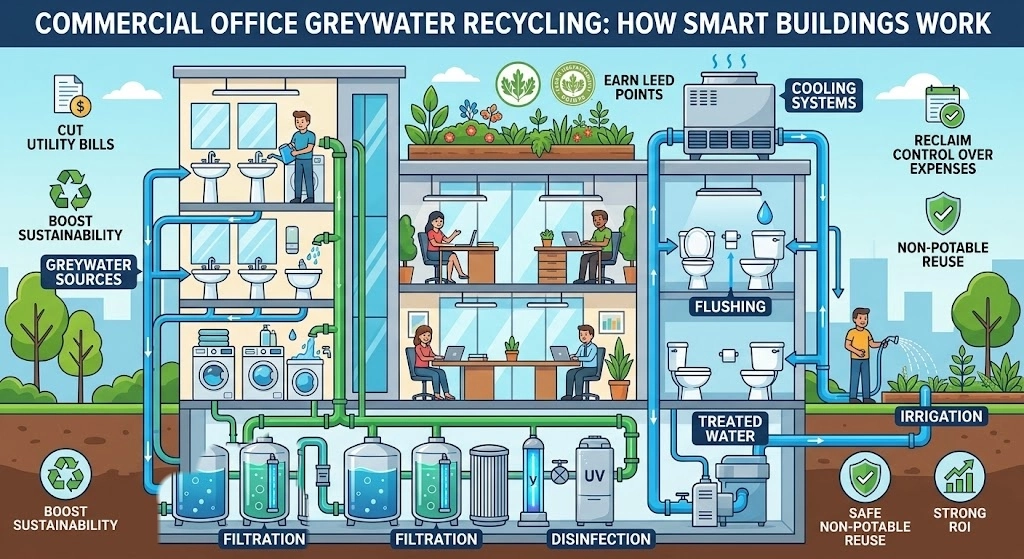
High-rise office buildings consume massive volumes of potable city water daily for non-drinking needs. Commercial office greywater recycling captures clean wastewater from lavatory sinks, decorative fountains, and cooling condensate before it enters municipal sewers. Instead of letting treated city water flush down toilets, modern buildings collect this discharge on-site.
Once collected, the liquid flows through multi-stage filtration units and advanced disinfection systems. The treated water satisfies strict safety guidelines set by the US EPA On-site Non-Potable Water Reuse Research framework. Property managers can safely supply non-potable demands like toilet flushing, landscape irrigation, and cooling tower makeup. Integrating commercial building water conservation strategies eliminates unnecessary resource waste while maintaining optimal operational performance.
Hidden Costs of Outdated Plumbing Architecture
Traditional commercial plumbing mixes all building drainage together into a single waste stream. This design forces property owners to pay twice: first to buy drinking-quality water for toilets, and second to discharge clean greywater into city sewers. Relying completely on municipal grids leaves commercial assets exposed to steep local rate hikes and seasonal water restrictions.
Upgrading outdated systems requires a forward-thinking office building plumbing design that separates greywater lines from blackwater sewage. Dual-pipe configurations direct sink drainage into localized treatment tanks rather than municipal mains. Modernizing plumbing layouts prevents costly urban sewer surcharges and shields real estate investments from escalating municipal utility expenses.
| Water Stream Type | Source Components | Typical Contaminant Level | Primary On-site Reuse Applications |
| Light Greywater | Bathroom sinks, handwashing stations, air conditioning condensate | Low microbial load | Toilet flushing, urinal flushing, subsurface irrigation |
| Dark Greywater | Kitchen dishwashers, breakroom sinks | Moderate organic matter and grease | Specialized irrigation after multi-stage filtration |
| Blackwater | Toilets, urinals, commercial kitchen food waste | High pathogen load | Requires full municipal or centralized biological treatment |
Elevating Asset Value with LEED Certification Water Reuse
Sustainable real estate attracts premium corporate tenants who demand verifiable environmental accountability. Modern smart water management for commercial real estate gives building owners a direct path toward earning high-value green building certifications. Automated monitoring equipment tracks daily gallon savings and provides real-time data for environmental compliance reporting.
Implementing non-potable recycling systems earns significant points under the USGBC TRUE Zero Waste Certification Guide and LEED Water Efficiency categories. These credentials enhance asset marketability, improve tenant retention rates, and lower overall operational overhead.
Financial ROI of On-site Water Recycling
Commercial property owners often worry about the initial cost of retrofitting existing infrastructure. However, calculating the commercial greywater system cost ROI reveals rapid payback periods driven by continuous utility savings. Reusing non-potable water cuts total municipal water consumption by up to forty percent.
Building managers cut monthly water bills while extending the operating lifespan of mechanical equipment. Reused water reduces chemical scaling in cooling towers and protects cooling loops from municipal supply interruptions. The combined reduction in water utility rates, sewer charges, and equipment repair costs ensures strong long-term financial returns.
Advanced Water Purification Technologies in Commercial Facilities
Modern commercial greywater treatment relies on multi-stage biological and physical filtration systems designed for continuous operation. Raw greywater passes through fine mesh mechanical strainers before flowing into membrane bioreactor treatment chambers. Microfiltration membranes remove suspended solids, fine particulate matter, and organic compounds with high precision.
Secondary treatment incorporates high-intensity ultraviolet disinfection alongside automated ozone dosing to destroy bacteria and pathogens. Automated sensor arrays continually evaluate turbidity, chlorine residuals, and total dissolved solids before clean water moves to storage distribution tanks. These multi-barrier treatment technologies ensure that recycled water maintains strict visual clarity and safety standards for daily building usage.
Key Technical Standards and Operational Milestones for Building Systems
Implementing localized water treatment requires strict adherence to engineering standards and maintenance protocols to maintain continuous water purity:
- Continuous digital turbidity monitoring ensures treated water remains completely clear before passing into main storage tanks.
- Dual-pipe isolation valves eliminate cross-connection risks between reclaimed non-potable loops and potable city drinking water lines.
- Microfiltration membrane pore sizes down to point-zero-two microns effectively strain out ultra-fine suspended particles and microbes.
- Automated dosing pumps maintain precise chlorine residuals inside distribution loops to prevent bacterial regrowth during storage.
- High-output ultraviolet disinfection tubes provide instant multi-log pathogen reduction without relying heavily on aggressive chemicals.
- Regular backwashing cycles automatically clean filtration membranes, extending overall filter life and maintaining continuous flow volume.
- Variable-frequency drive pumps dynamically adjust pressure delivery based on real-time tenant usage across multi-story distribution risers.
- Automated diversion valves immediately route incoming greywater to sewer lines if storage tanks reach full operating capacity.
- Remote telemetry equipment broadcasts real-time system performance data directly to building management systems for central monitoring.
- Routine quarterly sampling verifies that discharge meets localized non-potable microbial benchmarks for commercial indoor applications.
Regulatory Compliance and Local Permitting for Commercial Reuse
Navigating municipal plumbing codes and local environmental mandates is a crucial step when implementing on-site water treatment infrastructure. Regional authorities enforce specific guidelines regarding backflow prevention, cross-connection control, and water testing frequency to protect public health. Aligning your engineering plan with local health standards prevents costly installation delays and compliance penalties.
Working with specialized engineers ensures that system blueprints comply with IPC (International Plumbing Code) and UPC (Uniform Plumbing Code) greywater standards. Modern recycling setups feature automated safety shutoff valves that isolate recycled water loops if power fails or water quality parameters shift. Proper compliance documentation simplifies annual building inspections and reinforces occupant confidence in building safety.
Essential Steps for Engineering a Custom Recycling System
Successful adoption requires a tailored implementation plan designed around building occupancy and daily water usage patterns. Specialized engineers evaluate peak flows, space availability, and existing plumbing layouts to build an efficient system.
- Perform a thorough site audit to measure daily sink discharge and non-potable water demand.
- Install dual-pipe plumbing systems that separate reusable greywater from blackwater lines.
- Select continuous filtration and UV disinfection technology to match targeted end uses.
- Set up smart monitoring sensors to track water quality and automate maintenance alerts.
Reclaiming Control Over Operational Expenses
Commercial real estate leaders cannot afford to waste capital on unnecessary utility bills. Installing an automated recycling infrastructure transforms routine building drainage into a dependable internal supply. Properties using commercial office greywater recycling cut operating expenditures, boost property values, and secure long-term water resilience.
Frequently Asked Questions
What is commercial office greywater recycling?
It is the process of capturing, filtering, and treating gently used water from office sinks and cooling systems. The recycled water safely powers non-potable needs like toilet flushing and irrigation.
Is treated greywater safe for office workers?
Yes, modern systems use advanced filtration and UV disinfection to clean the water. Treated water meets strict health standards and is kept separate from drinking water supplies.
How does greywater recycling cut operating costs?
Reusing water significantly reduces monthly municipal water purchases and sewer discharge fees. Lowering overall demand creates ongoing utility savings that improve total property profitability.
Can existing office buildings install greywater systems?
Yes, retrofitting existing properties is very common. Engineers evaluate current plumbing layouts and install compact treatment units to collect and distribute non-potable water efficiently.
What building fixtures connect to greywater systems?
Greywater originates from bathroom handwashing sinks, bathtubs, and air conditioning condensate. Once treated, it safely feeds toilet flushing tanks, urinal units, and outdoor sprinkler networks.
How does water recycling help earn green building certifications?
Recycling on-site water reduces total municipal water use, directly earning points for LEED and TRUE programs. High certification levels increase building valuation and attract eco-conscious corporate tenants.
What routine maintenance do commercial greywater systems require?
Systems require periodic filter inspections, sensor calibrations, and routine disinfection checkups. Automated smart controls monitor daily operations and alert facility staff whenever preventative maintenance is required.
What is the typical financial payback period for greywater technology?
Most commercial property owners achieve full return on investment within three to five years. Savings depend on local water rates, daily building occupancy, and system sizing.
Does greywater recycling protect buildings during municipal water shortages?
Yes, on-site recycling creates an independent internal supply for daily toilet flushing and mechanical cooling. Buildings maintain normal operations even during regional drought restrictions or utility outages.
Key Takeaways
- On-site recycling reduces office building municipal water demand by up to forty percent.
- Separating greywater lines protects commercial real estate from rising municipal sewer rates.
- Modern water management earns valuable points toward recognized LEED green building certifications.
- Automated system monitoring ensures high water quality standards and simple maintenance tracking.
Upgrade Your Commercial Property Infrastructure Today
Ready to eliminate unnecessary water waste and lower building operating costs? Explore our specialized Greywater Recycling Services to design an efficient non-potable water system for your commercial facility. Contact our team through our Custom Water Systems Consultation page to schedule an architectural audit.