TL;DR: A graywater system collects water from showers, sinks, and laundry, filters it, and routes it back into your home for toilet flushing, irrigation, and more. It can cut your household water use by up to 40 percent. This guide explains exactly how the graywater treatment process works, what WRS installs, and why it matters right now in Southern California.
Understanding how a graywater system works is the first step to changing that. A graywater system captures that lightly used water, runs it through a graywater filtration process, and puts it back to work in your home or on your property. No new water needed. No extra cost to the city. Just smarter use of what you already have.
Water Recycling Systems (WRS) has been designing and installing NSF-350 certified graywater plumbing solutions in Los Angeles since 2006. This is how the systems work and why more homeowners and businesses are making the switch.
What Is Graywater and Where Does It Come From?
Graywater is the wastewater generated by your home that does not come from toilets. That includes water from:
- Showers and bathtubs
- Bathroom sinks
- Laundry machines
- Commercial sinks and equipment in non-kitchen areas
It does not include toilet water (called blackwater) or kitchen sink water, which carries food waste and grease. Graywater is not clean enough to drink. But it is clean enough, after graywater filtration, to be used for irrigation, toilet flushing, hard surface washdown, and filling decorative water features.
According to the EPA Guidance Manual on Graywater Separation, graywater constitutes a significant portion of household wastewater. States including California, Arizona, Nevada, and Texas allow graywater reuse when systems meet safety standards. WRS installs systems that fully comply with California’s legal framework for home water reuse.
How Does a Graywater System Work Step by Step?
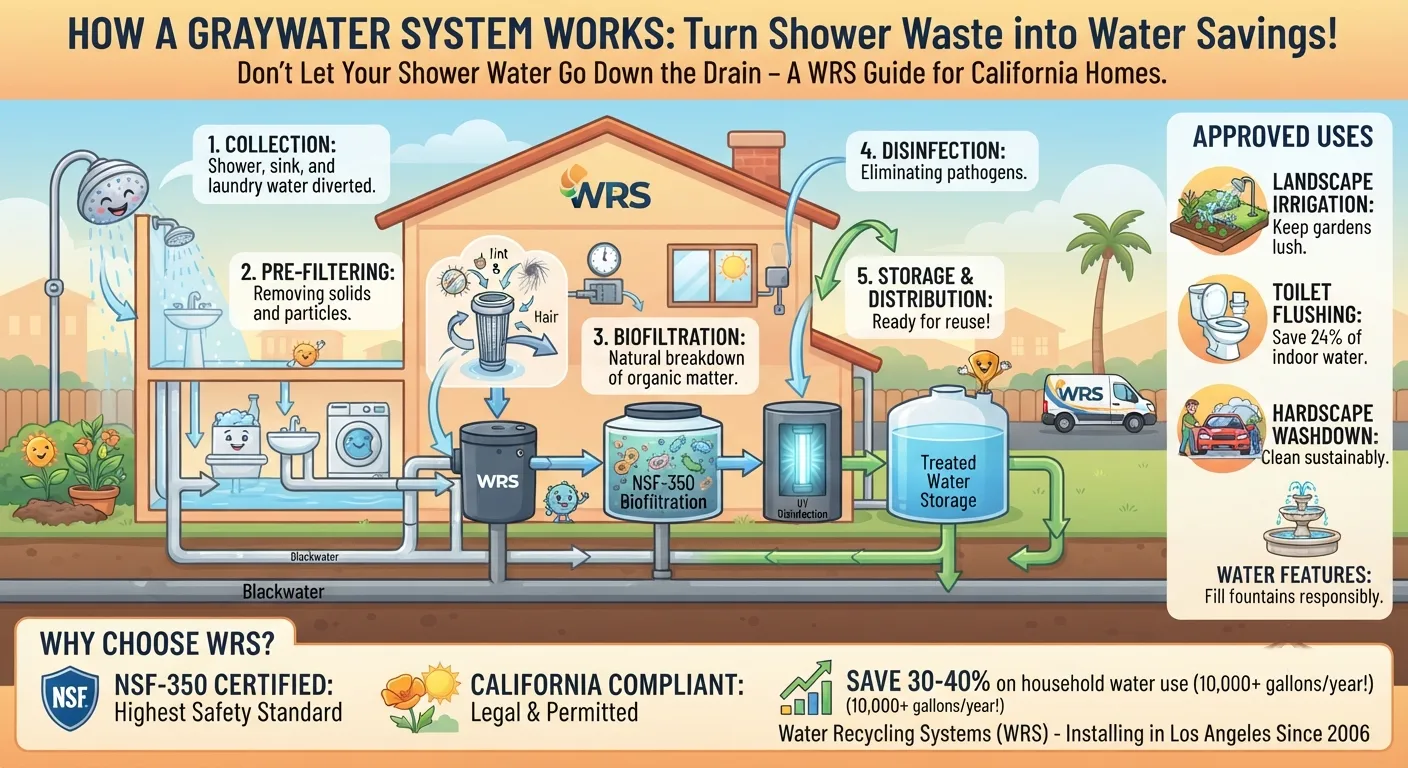
The graywater treatment process at WRS follows a clear sequence. Each step is designed to remove contaminants and make the water safe for its intended reuse application.
- Step 1 Collection: Graywater from showers, sinks, and laundry is routed through separate pipes that divert it away from the main sewer. This is where graywater plumbing begins.
- Step 2 Pre-Filtering: The collected water passes through an initial filter that removes hair, lint, and large particles before the main treatment stage.
- Step 3 Biofiltration: NSF-350 certified biofiltration uses natural biological processes to break down organic material. Beneficial microorganisms consume contaminants in the water.
- Step 4 Disinfection: After biofiltration, UV light or chemical disinfection eliminates any remaining pathogens to meet safety standards for the intended reuse application.
- Step 5 Storage and Distribution: Treated water is stored in a tank and pumped automatically to irrigation lines, toilet supply, outdoor taps, or water features.
The result is a closed-loop water recycling process that runs automatically. You do not manage it day to day. The system handles collection, treatment, and distribution on its own.
What Can Treated Graywater Be Used For?
A properly filtered graywater system unlocks several high-value uses for water that would otherwise be wasted. At WRS, installed systems support:
- Landscape and garden irrigation: Treated graywater works well for drip irrigation on lawns, trees, and garden beds without surface contact concerns.
- Toilet flushing: Toilets use roughly 24 percent of indoor home water. Replacing that with recycled water is one of the highest-impact home water reuse applications.
- Hardscape washdown: Driveways, patios, and commercial surfaces can be cleaned with treated graywater instead of potable water.
- Water features: Decorative fountains and ponds can be filled and maintained using recycled graywater without tapping the main supply.
The EPA Onsite Non-Potable Water Reuse Resources 2024 confirms that onsite graywater recycling significantly reduces reliance on imported water and is one of the most scalable approaches to residential water conservation available.
You can see real WRS installations across Los Angeles and Southern California on the WRS project gallery. Every project shows the system in a real home or commercial building context.
What Makes WRS Graywater Systems Different?
Not every graywater treatment process is the same. WRS systems are NSF-350 certified, which is the highest independent standard for recycled water treatment. This matters because it means the system has been tested and verified to produce water that meets safety benchmarks for toilet flushing, irrigation, and other non-potable uses.
Here is what sets WRS apart from basic or uncertified graywater setups:
- NSF-350 certification: Every WRS system meets this federal standard. No guesswork on safety or performance.
- Biofiltration technology: More effective and lower maintenance than many other graywater filtration options on the market.
- Full legal compliance: WRS designs systems that comply with California regulations for graywater plumbing and reuse.
- Commercial and residential experience: Clients include Eataly LA, Paul Mitchell, and the Santa Monica Public Library.
Learn more on the WRS Greywater Recycling Systems page or explore the WRS FAQ page for technical questions about installation and compliance.
Graywater vs. Blackwater: Treatment, Compliance, and Applications
| Feature / Category | Graywater (WRS Systems) | Blackwater |
| Source | Showers, bathtubs, bathroom sinks, and laundry machines. | Toilets (and kitchen sinks). |
| Treatment Process | Diverted via separate plumbing, pre-filtered, biofiltered, and disinfected (UV/chemical). | Requires full municipal sewage or septic treatment. |
| Safety Certification | NSF-350 certified for safety and non-potable reuse. | High pathogen load; strictly regulated hazardous wastewater. |
| Approved Reuse | Subsurface irrigation, toilet flushing, hardscape washdown, and water features. | None (can’t be reused on-site safely). |
| Water Savings Impact | Cuts household water usage by 30% to 40% (10,000+ gallons saved annually). | Not applicable (discarded). |
How Much Water Does a Graywater System Actually Save?
This is the question most homeowners ask first. The answer depends on your household size, water use habits, and how the system is configured. But the numbers are meaningful.
On average, a typical household can redirect between 30 and 40 percent of its total water use through a graywater system. In a home using 100 gallons per day, that is 30 to 40 gallons saved daily. Over a year, that adds up to more than 10,000 gallons.
For commercial properties, the numbers scale significantly. A building with high shower or laundry volume can recycle tens of thousands of gallons per month through a properly sized water recycling process.
In California, where water costs rise steadily and drought is a consistent reality, those savings hit your utility bill and improve long-term water security. WRS helps clients find available rebates on the WRS rebates page, which can offset installation costs.
Ready to see what a system looks like for your property? Visit the WRS contact page for a quote. Or read more on the WRS blog for the latest in graywater and rainwater recycling.
Frequently Asked Questions
How does a graywater system work in a home?
A graywater system collects water from showers, sinks, and laundry, filters it through a biofiltration and disinfection process, stores it in a tank, and redistributes it for toilet flushing, irrigation, and other non-potable uses automatically.
Is graywater safe to use around my home?
Yes, when treated by a certified system. WRS uses NSF-350 certified biofiltration and disinfection that meets all state and federal safety standards. Treated graywater is safe for irrigation, toilet flushing, hardscape washdown, and water features.
What is the graywater treatment process?
The process involves collection, pre-filtering of solids, biofiltration to remove organic contaminants, UV or chemical disinfection to eliminate pathogens, storage in a tank, and automatic distribution to approved non-potable uses throughout your property.
Is a graywater system legal in California?
Yes. California permits graywater reuse when systems meet state code requirements. WRS designs and installs systems that are fully compliant with California regulations and NSF-350 certified, so you face no permit or legal complications after installation.
What is the difference between graywater and blackwater?
Graywater comes from showers, sinks, and laundry and can be treated for reuse. Blackwater comes from toilets and contains pathogens that require full sewage treatment. WRS systems handle only graywater, which is collected through a separate dedicated pipe system.
How much water can a graywater system save?
A typical household can save 30 to 40 percent of its total water use by routing graywater through a recycling system. That equals more than 10,000 gallons per year for an average home, with commercial properties saving significantly more depending on their size.
What does graywater filtration involve?
Graywater filtration at WRS uses NSF-350 certified biofiltration, which employs beneficial microorganisms to break down organic material in the water. This is followed by disinfection to meet safety standards before storage and redistribution for approved uses.
Can a graywater system be installed in an existing home?
Yes. WRS installs graywater plumbing in both new construction and existing residential and commercial properties. The installation involves separating graywater drain lines from the main sewer system and connecting them to the treatment and storage equipment.
How do I get a graywater system quote from WRS?
Visit the WRS contact page to request a project quote. WRS serves residential and commercial clients across Southern California and can assess your property’s specific graywater potential and system requirements.
Key Takeaways
- A graywater system collects water from showers, sinks, and laundry and recycles it for toilet flushing, irrigation, and washdown uses after filtration.
- The graywater treatment process at WRS uses NSF-350 certified biofiltration and disinfection for safe, legally compliant water reuse.
- Average households can save over 10,000 gallons of potable water per year by switching to a home water reuse system.
- California allows graywater reuse when systems meet code requirements. WRS handles full compliance, permitting, and installation.
- WRS has 18 years of experience and has installed systems for major commercial and residential clients across Southern California.
Your Water Is Worth Reusing, Find Out How
Every gallon that goes down your drain and into the sewer is a gallon you already paid for. A graywater system from WRS puts that water to work instead. The technology is proven, the process is certified, and the savings are real.
Get a quote by visiting the WRS contact page today. And explore the WRS Greywater Recycling Systems page to see exactly what a system can do for your home or commercial property.